Florida's warm temperatures and high humidity make moisture management an important part of responsible homeownership. While a little humidity may seem harmless, persistent moisture can contribute to conditions where mold develops inside residential properties. Leaks, condensation, poor ventilation, flooding, and air-conditioning issues can all create opportunities for unwanted microbial growth.
Because mold is not always visible, homeowners may have questions when they notice musty odors, water stains, or recurring dampness. Professional florida mold testing can provide useful information when there is a specific reason to investigate indoor environmental conditions.
Mold needs moisture and a suitable surface to grow. Florida's climate can make moisture control particularly challenging, especially during periods of high humidity and heavy rainfall.
Water can enter a property through many different pathways. Roof leaks, plumbing failures, damaged windows, drainage problems, flooding, and HVAC condensation are common examples of conditions that may require attention.
The important issue is not simply whether mold spores exist. Mold spores can naturally occur in indoor and outdoor environments. The greater concern is identifying unusual conditions, visible growth, moisture sources, or patterns that warrant further investigation.
There is no reason for every homeowner to order testing routinely. An evaluation is generally more useful when there is a specific concern that needs to be investigated.
Homeowners may consider professional assessment when they notice:
The appropriate approach depends on the circumstances. In some cases, a visual inspection and moisture assessment may provide more useful information than air sampling alone.
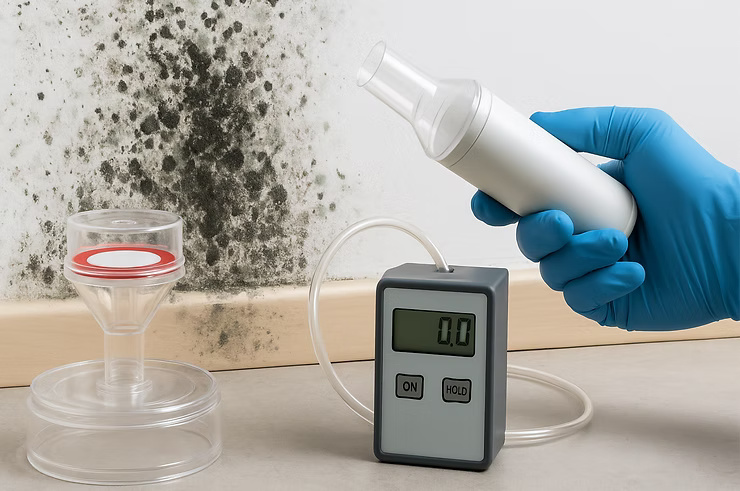
Testing methods can vary depending on the property and the reason for the evaluation. A qualified professional may first look for visible evidence of moisture or suspected microbial growth.
When sampling is appropriate, samples may be collected from indoor air or surfaces and submitted for laboratory analysis. The type and number of samples depend on the specific situation.
Testing should be viewed as one part of a broader assessment. Laboratory results need to be interpreted alongside building conditions, moisture observations, property history, and other relevant information.
A single sample should not automatically be treated as a complete representation of an entire building.
Indoor air naturally contains particles and microorganisms. Mold spores can also enter homes from outdoors, meaning that detecting spores in an air sample does not automatically prove that there is a significant indoor mold problem.
Results can vary based on weather, ventilation, occupancy, HVAC operation, and other conditions at the time of sampling.
For this reason, homeowners should be cautious about conclusions based solely on one test result. A qualified professional can help explain what the findings may indicate and whether additional investigation is appropriate.
Testing can provide information, but it does not eliminate the underlying cause of mold growth.
If a roof is leaking, a pipe is damaged, or indoor humidity remains consistently high, those conditions need to be addressed. Otherwise, moisture can continue creating an environment favorable to microbial growth.
Depending on the problem, homeowners may need assistance from a roofing contractor, plumber, HVAC professional, restoration company, or other qualified specialist.
Fixing the moisture source is often one of the most important steps in managing a mold-related concern.
Buying a home is a major investment, and buyers want to understand more than what can be seen in listing photographs.
Properties with a history of flooding, water intrusion, prolonged vacancy, or visible moisture concerns may deserve additional attention during the due-diligence process.
A standard home inspection can identify many accessible property conditions, while specialized environmental evaluation can be considered when there are specific indications of concern.
Professional florida mold testing may help provide additional information when circumstances justify sampling or laboratory analysis.
Buyers should review findings carefully and seek appropriate specialist advice when significant concerns are identified.
Mold-related concerns can also become a source of uncertainty during a home sale. Sellers who are aware of moisture problems may choose to investigate them before listing.
Addressing concerns early can give homeowners more time to determine the cause, obtain repair estimates, correct appropriate problems, and organize relevant documentation.
This does not guarantee that buyers will have no questions, but proactive preparation can make the transaction process more transparent.
The best strategy is often to prevent moisture problems before they become significant.
Homeowners should maintain gutters and downspouts, inspect roofs periodically, repair plumbing leaks quickly, and make sure bathrooms and kitchens have suitable ventilation.
Air-conditioning systems should also receive appropriate maintenance. In Florida, HVAC performance can have a major effect on indoor humidity levels.
Homeowners can also monitor areas beneath sinks, around windows, near exterior doors, and around HVAC equipment for signs of moisture.
DIY mold test kits can appear convenient, but interpreting environmental conditions is more complicated than simply obtaining a laboratory result.
A professional evaluation considers the property's construction, moisture history, accessible areas, visible conditions, and the reason for testing. This broader perspective can help homeowners avoid unnecessary conclusions.
If a significant concern is discovered, the appropriate next step may involve additional investigation or specialized remediation.
Mold concerns should be approached with evidence rather than assumptions. Not every stain is mold, and the presence of airborne spores does not automatically establish a serious indoor problem.
For Florida homeowners in 2026, florida mold testing can be a useful component of an environmental assessment when there is a reasonable concern about moisture or suspected microbial growth.
The most effective approach combines appropriate evaluation, moisture control, responsible maintenance, and professional guidance when necessary. Understanding what testing can—and cannot—tell you allows homeowners to make practical decisions while protecting the condition of their property.
Whether you're buying, selling, or maintaining a Florida home, staying alert to moisture problems can help you address concerns earlier. A proactive approach today can make property maintenance easier and reduce the chance that a small moisture issue develops into a much larger problem.

This post has been authored and published by one of our premium contributors, who are experts in their fields. They bring high-quality, well-researched content that adds significant value to our platform.









Paris in France is your trusted source for Paris travel guides, cultural insights, attractions, lifestyle articles, and local experiences. Explore the beauty and charm of Paris with us.